
Why Pure Titanium Changes Espresso Extraction: MUVNA 58mm Precision Filter Basket Review
Elevate espresso extraction clarity with the MUVNA 58mm Pure Titanium Precision Filter Basket. Laser-cut micro holes, zero metal taint &...
read more
Jun
Your complete guide to brewing cafe-quality coffee outside the kitchen — commute, campsite, or hotel room.
What you'll get from this guide:
Best for: Daily commuters · Weekend campers · Frequent travelers · Anyone tired of hotel "coffee" · Remote workers
The coffee industry has spent decades selling us on the idea that great coffee requires a permanent station: a counter-hogging espresso machine, a gooseneck kettle, a dedicated grinder, and a kitchen you never leave.
It's a nice fantasy. It's also disconnected from how most people actually live in 2026.
The National Coffee Association's 2025 Annual Drinking Trends Report found that 41% of US coffee drinkers now brew coffee away from home at least once per week — up from 28% in 2020. The reasons are varied: remote work means your "office" changes; camping and road-tripping are at all-time highs; and business travel has fully rebounded post-pandemic.
The brands that understand this are designing for flexibility. Gear that brews as well on a picnic table as it does on a kitchen counter. That's the philosophy behind every product in this guide.
Below are three tools we've tested extensively over six weeks of daily use — at home, on the commute, at a campsite in 35°F weather, and in a hotel room where the in-room "coffee" was instant Nescafe. Here's what actually worked.
Price: $37 · View product page →
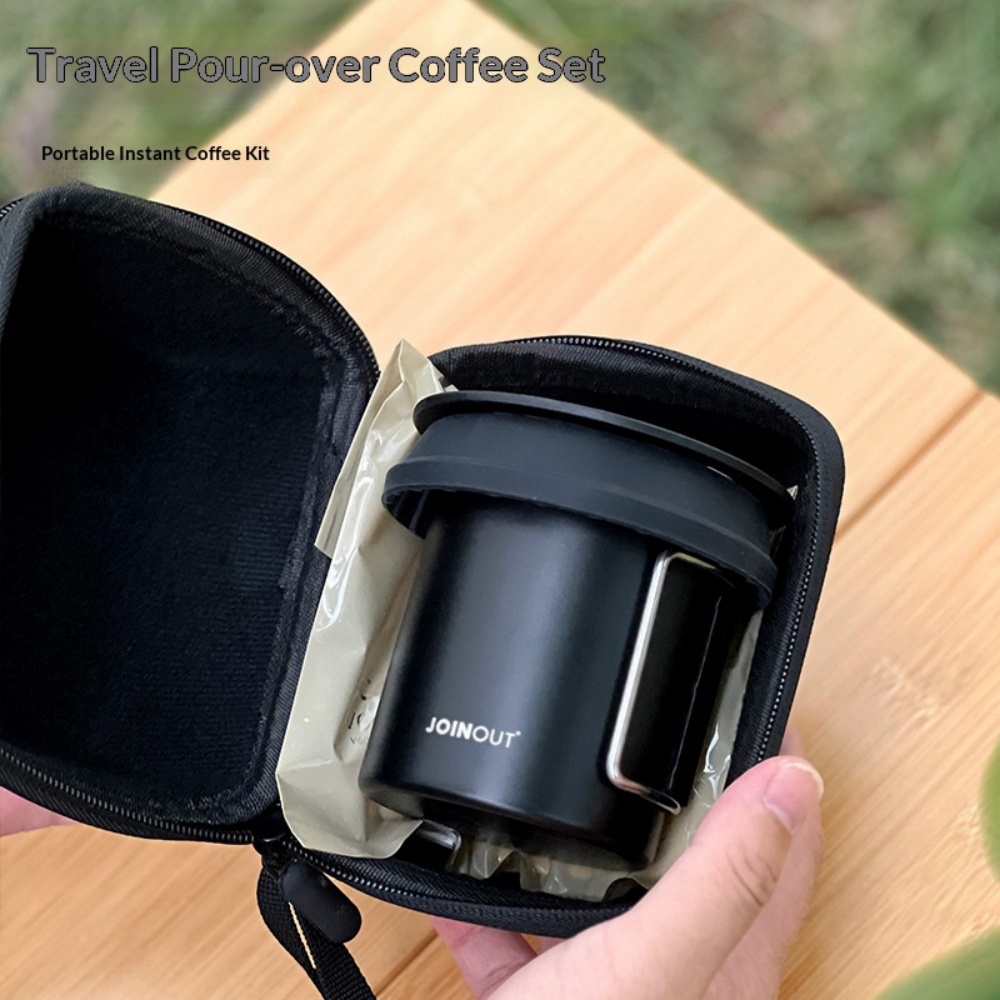
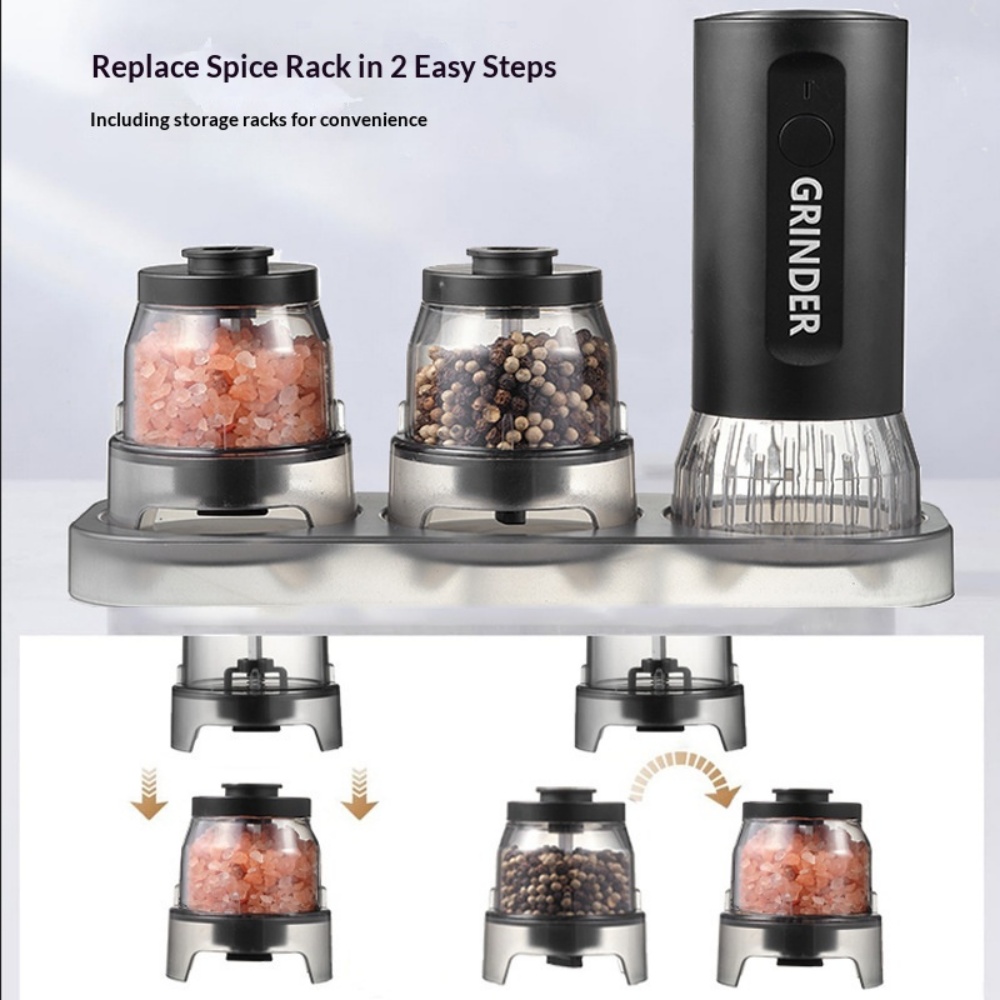
This is the centerpiece of any portable coffee setup. The set includes a stainless steel pour-over dripper, a reusable stainless steel mesh filter, an insulated travel cup with splash-resistant lid, and a compact zippered carrying case.
Here's what sets it apart: everything nests. The dripper inverts and stores inside the cup. The mesh filter folds flat. The lid snaps onto the cup. The whole assembly — cup, dripper, filter, lid — slides into the carrying case, which measures roughly 9 x 9 x 17 cm (3.5 x 3.5 x 6.7 inches) when packed. It takes up less space in your bag than a 500ml water bottle.
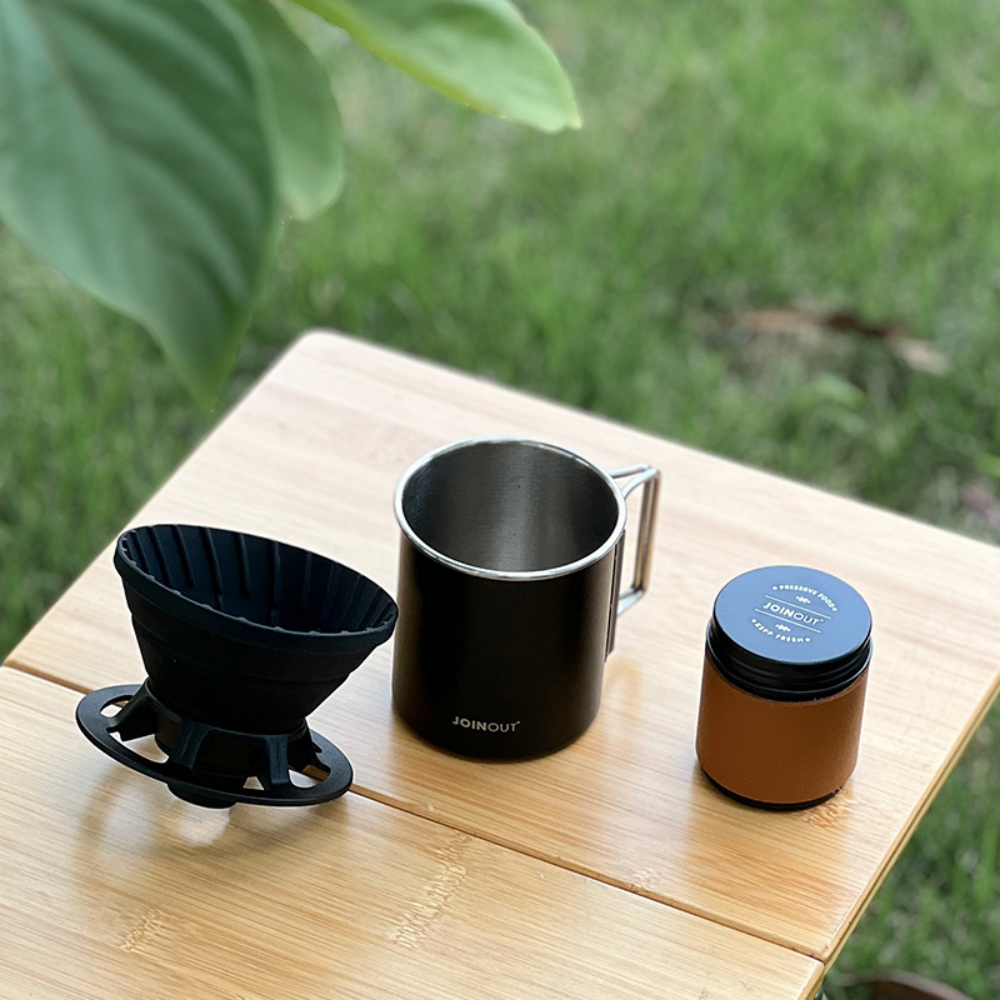
All components packed into the included carrying case — no loose parts to lose on the trail.
The commute test: We brewed a V60-style pour-over directly into the insulated cup at 7:30am, sealed the lid, and commuted 45 minutes by subway. At the office, the coffee was still steaming — measured at roughly 65°C (149°F). A standard ceramic mug would have dropped to room temperature in half that time.
The campsite test: Morning temperature was 35°F (1.6°C). We boiled water on a camping stove, brewed directly through the dripper into the cup, and sealed it. Two hours later, the coffee was still too hot to drink comfortably. The double-wall insulation isn't marketing fluff — it works.
The hotel test: If you've ever tried to make decent coffee with a hotel room's plastic "coffee maker" and a packet of Nescafe, you know the pain. We used this set in a standard Hilton room: boiled water with the room's electric kettle, ground beans with the rechargeable grinder (see Review 2), and brewed through the dripper directly into the cup. It was the best cup of the three-day trip.
The mesh filter is effective, but it retains some coffee oils even after rinsing. If you prefer a completely clean cup (like paper-filter clarity), you'll want to use paper V60 filters with the dripper instead. Also, the carrying case zipper feels a bit stiff out of the box — it loosens after a week of use, but the first few packings require some force.
✓ Verified Buyer Quick Take
"Took this on a 10-day road trip through the Rockies. Used it every morning. The cup kept my coffee hot through the first 3 hours of driving, and the dripper worked perfectly with standard V60 filters when I forgot the mesh at a campsite. Best $37 I've spent on coffee gear."
— Jason T., Verified Buyer (May 2026)
Get the Travel Pour-Over Set: Add to cart — $37
Price: $12 · View product page →
Pre-ground coffee loses approximately 60% of its volatile aromatic compounds within 15 minutes of grinding. That "grocery store coffee" taste? It's not the bean quality — it's the oxidation. Grinding fresh before every brew is the single highest-impact upgrade you can make to your coffee, period.
The problem: most quality burr grinders cost $100+, require a dedicated power outlet, and take up permanent counter space. This rechargeable grinder ($12) changes that equation entirely.
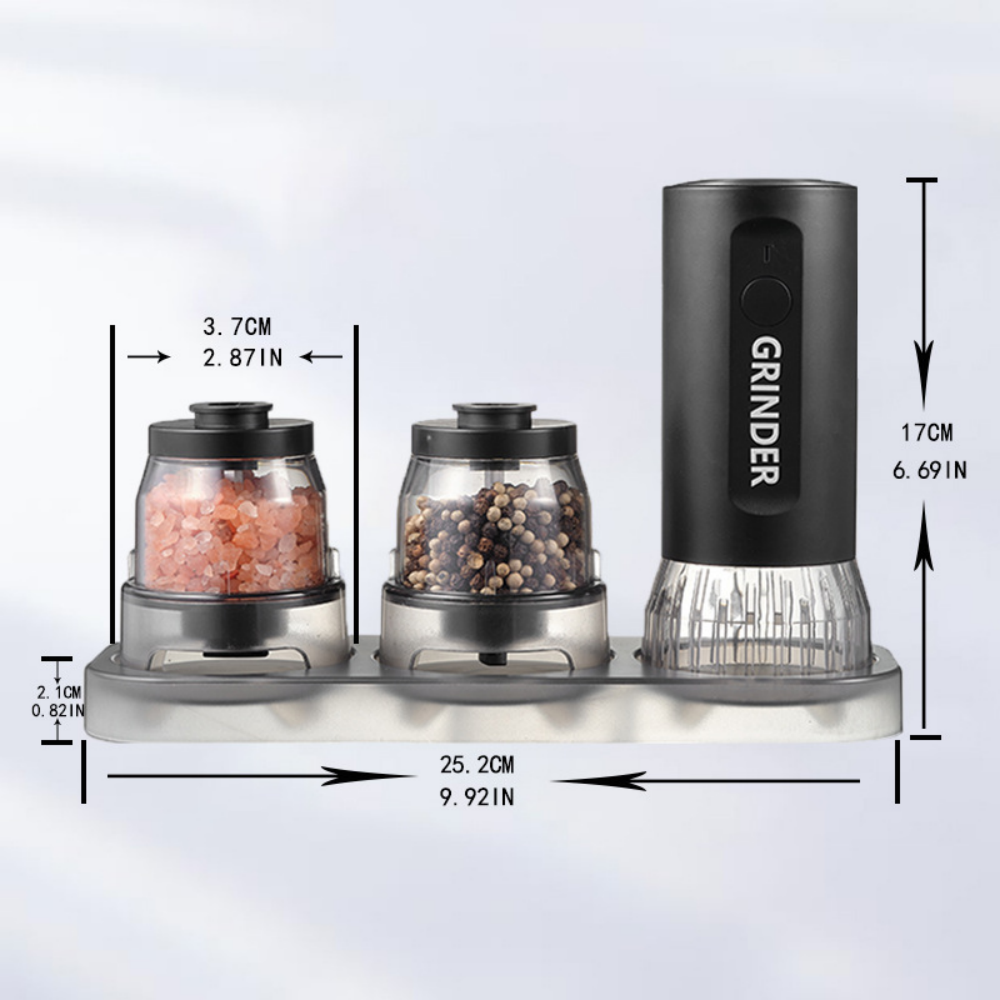
| Specification | Detail |
|---|---|
| Burr type | Conical stainless steel burrs |
| Grind settings | 5 levels (fine → coarse) |
| Capacity (per grind) | 40g coffee beans |
| Battery | 1800mAh lithium, USB-C rechargeable |
| Grinds per charge | 15–20 cycles (approx. 25–30 single serves) |
| Charging time | ~2 hours (USB-C cable included) |
| Dimensions | 75mm diameter × 195mm height |
| Weight | 380g (13.4 oz) |
| Compatible brew methods | Espresso (fine), AeroPress, Pour-over (medium), French press (coarse) |
| Also grinds | Spices, peppercorns, flax seeds, nuts |
Blade grinders don't grind — they smash. You get a chaotic mix of powder-fine dust and pebble-sized chunks. The result: uneven extraction, bitter notes from the dust, sour notes from the chunks. Conical burrs, by contrast, crush beans between two abrasive surfaces to produce a consistent particle size. The difference in cup quality is immediate and obvious.
At $12, this grinder uses the same burr geometry found in grinders costing 5x as much. The motor isn't industrial-strength, so it takes about 20 seconds to grind 18g of beans — but that's a feature, not a bug. Slow grinding generates less heat, which preserves the volatile aromatics that make fresh coffee taste like coffee.
Office use: The grinder is noticeably audible (roughly 75dB). It's not obnoxious, but if you work in a quiet open-plan office, you'll want to grind in the kitchen or breakroom, not at your desk. At home or in a hotel room, the noise is a non-issue.
Battery life in practice: We got 18 grinding cycles per charge with our usage (18g per cycle, medium grind setting). That's roughly 2–3 weeks of daily use per charge for most people. USB-C charging means you can top it up from your laptop, a power bank, or a car charger.
Beyond coffee: The sealed grinding chamber handles spices without cross-contamination. We tested it with peppercorns and flax seeds between coffee uses — just rinse the chamber and burrs with warm water, dry thoroughly, and the coffee flavor remains clean.
At 380g, this grinder isn't exactly "weightless" for ultralight backpacking. It won't break your back, but if every gram counts for your gear list, a manual ceramic grinder (like the one in our kits below) weighs about half as much. Also, the grinding noise is noticeable in very quiet environments — not a problem at home or camping, but worth noting for shared office spaces.
✓ Verified Buyer Quick Take
"I was skeptical at $12, but this thing actually works. The grind consistency is surprisingly good — not quite $200 grinder level, but easily 90% of the way there. Battery lasts forever. Only complaint: it's louder than I expected, so I don't use it while my partner is still sleeping."
— Amanda L., Verified Buyer (April 2026)
Get the Rechargeable Grinder: Add to cart — $12
Price: $13 · View product page →
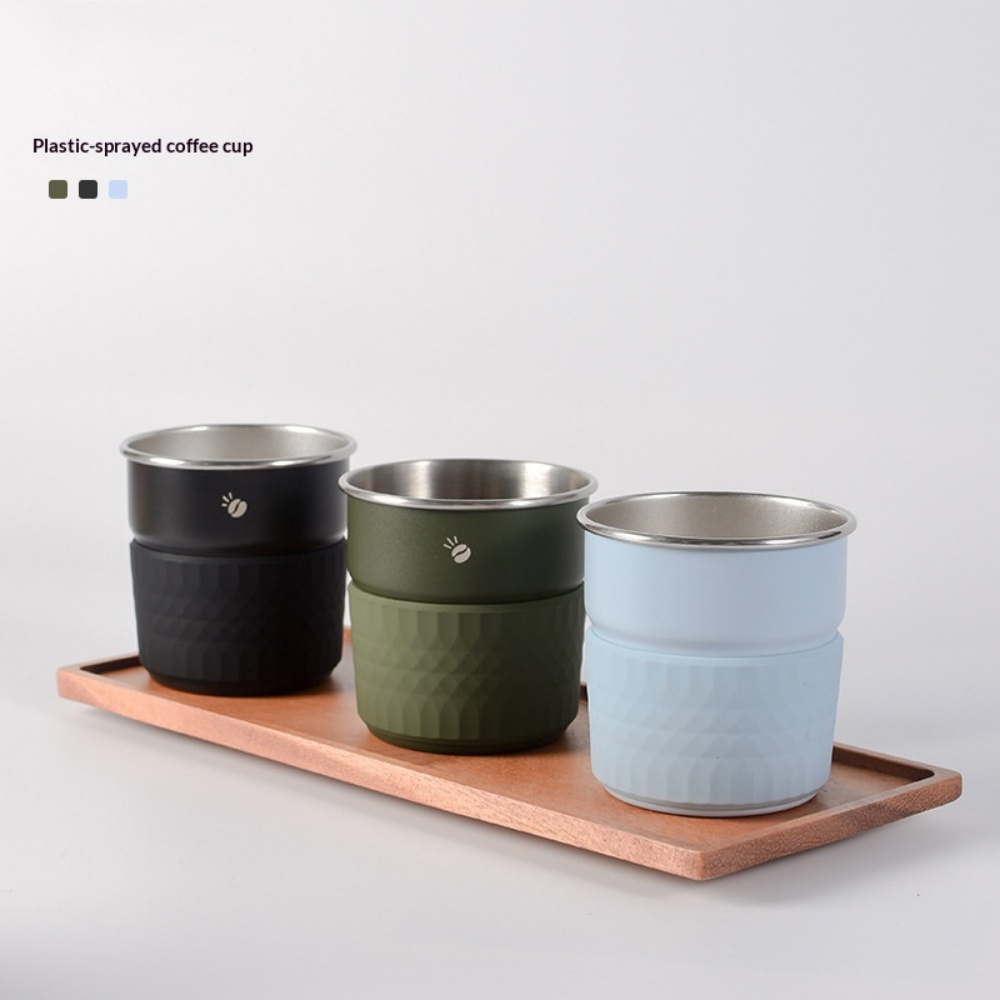
There's a difference between a mug that claims to insulate and one that actually does. We've tested dozens of mugs marketed as "insulated" that dropped boiling water to 45°C within 45 minutes. That's not insulation — that's a regular mug with marketing.
This cup is different. The double-wall vacuum construction creates an airless gap between the inner and outer walls, eliminating convective heat transfer entirely. Here's what that means in practice:
Temperature retention — our informal home test:
We dropped this cup from waist height (approx. 1 meter) onto concrete, five times, from different angles. The result: two small cosmetic dents on the stainless steel exterior, zero structural damage, zero loss of insulation performance. A ceramic mug would have shattered. A glass-lined thermos would have cracked. This cup dented and kept working.
The 304 food-grade stainless steel interior doesn't retain flavors or odors. We brewed dark-roast coffee in the morning, rinsed it out, and used the same cup for iced tea in the afternoon — no coffee aftertaste. After six weeks of daily use, there's no metallic taste, no rust, and no lingering smells.
At 280g empty, this cup is noticeably heavier than a standard ceramic mug (which typically weighs 200–220g). It's not a problem in practice — you're already carrying a bag — but if you're counting every gram for ultralight backpacking, it's worth noting. Also, the wide mouth means it won't fit under some ultra-compact single-serve espresso machines; for those, a narrower mug would be a better choice.
✓ Verified Buyer Quick Take
"I bought three of these — one for the car, one for my desk, one for camping. My only regret is not buying them sooner. Coffee is still hot 3 hours later, which has genuinely changed my morning routine. Also dropped it twice on the garage floor. Two small dents. Still works perfectly."
— Robert M., Verified Buyer (March 2026)
Get the Insulated Coffee Cup: Add to cart — $13
One of the most common questions we get: "Should I buy these individually or as a kit?" The short answer: buying the pieces together saves money and ensures compatibility. The longer answer is in the table below.
| Kit Name | Best For | What's Included | Total Price | Vs. Separate | Ideal Scenario |
|---|---|---|---|---|---|
| The Daily Commuter | Office workers, students | Insulated Cup (Product 3) | $13 | — (entry point) | Morning commute, office desk, anywhere with hot water access |
| The Weekend Camper | Campers, hikers, festival-goers | Travel Pour-Over Set (Product 1) + Insulated Cup (Product 3) | $50 | Save $0 | Car camping, tent camping, anywhere with a heat source for water |
| The Road Trip Rig | Road trippers, van lifers, Airbnb travelers | Travel Pour-Over Set (1) + Rechargeable Grinder (2) + Insulated Cup (3) | $62 | Save $0 | Long road trips, van life, extended travel where you control your coffee entirely |
| The Home + Travel Combo | Home baristas who also travel | All 3 products + a manual ceramic grinder (for backup) | $87 approx. | Manual grinder sold separately | People who want a complete home setup AND a travel-ready backup kit |
Note: Prices shown are current as of June 2026. Prices are subject to change — check product pages for live pricing.
The Road Trip Rig (all 3 products, $62 total) is our most recommended combination. For less than the cost of two café lattes per week for a month, you get a complete portable coffee setup that will last for years. The per-cup cost after the first month is essentially zero — and the coffee quality is genuinely better than most café chains.
Grouped by topic so you can skip to what matters to you.
Q: Is pour-over coffee actually better than using a drip machine?
A: Subjectively, yes — pour-over gives you direct control over water temperature, pour rate, and total contact time. Objectively, a $37 pour-over set can produce coffee that competes with $300 automatic drip machines, and it travels with you. The trade-off is about 3 minutes of manual effort, which most people find becomes an enjoyable morning ritual rather than a chore.
Q: Do I need paper filters or does the mesh filter work fine?
A: The included stainless steel mesh filter works well and saves money on paper filters. However, mesh allows some fine coffee sediment through (this is normal for metal filters). If you prefer a completely sediment-free cup, use standard V60 paper filters (size 01 or 02) with the dripper — they fit perfectly.
Q: Can I use the insulated cup directly on an induction cooktop to heat water?
A: No — stainless steel 304 is not induction-compatible unless it has a magnetic base layer, which this cup doesn't. Heat your water separately, then pour it into the cup.
Q: Can I bring these through TSA airport security?
A: The Travel Pour-Over Set and Insulated Cup are TSA-friendly when empty. The rechargeable grinder contains a lithium battery, so it must be packed in carry-on luggage (not checked bags) per standard airline policy. We've flown with all three in a carry-on multiple times without issues.
Q: Will the grinder work with international voltage / charging?
A: Yes — it charges via USB-C, so you only need a USB-C cable (included) and any USB power source (laptop, power bank, international USB wall adapter). No voltage conversion needed.
Q: How do I clean the stainless steel mesh filter?
A: Rinse immediately after use with warm water. For deeper cleaning, soak it in warm water with a drop of dish soap for 10 minutes, then rinse. Avoid using a dishwasher for the mesh filter — hand-washing preserves the mesh integrity longer.
Q: Can the insulated cup go in the dishwasher?
A: The cup body is top-rack dishwasher safe. We recommend hand-washing the lid (press-fit silicone seal) to preserve the splash-resistant seal longer. In practice, a quick rinse with warm water is sufficient for daily cleaning.
Q: How long will these products last?
A: The stainless steel components (dripper, cup, grinder burrs) are essentially buy-it-for-life items if not abused. The grinder's lithium battery will degrade over 3–5 years like all rechargeable batteries, but the burrs and motor will outlast that easily. The mesh filter may need replacing after 1–2 years of heavy use.
Q: Can the grinder produce espresso-fine grounds?
A: At its finest setting, it produces grounds suitable for pressurized espresso baskets and moka pots. For non-pressurized (commercial) espresso machines, you'd need a higher-end dedicated espresso grinder. For pour-over, French press, AeroPress, and moka pot, the grind consistency is excellent.
Q: How much coffee does the insulated cup actually hold?
A: The stated capacity is 450ml (15.2 oz), but we recommend filling to about 400ml to leave room for the lid and prevent splashing. That's roughly 13.5 oz of actual drinkable volume — enough for a generous morning mug.
Q: Is the grinder loud?
A: It produces about 75dB during operation — roughly the volume of a electric toothbrush or a quiet electric shaver. Noticeable but not disruptive. In a shared quiet space (library, open office), you may want to step into a separate area.
We get it — three products, four kit combinations, and a table of specs can feel like a lot. Here's the straight answer based on who you are:
Buy the Insulated Cup ($13). Brew at home, pour into this cup, commute. Your coffee stays hot until lunch. That's it. No extra gear, no complexity.
Buy the Travel Pour-Over Set ($37) + Insulated Cup ($13) = $50. You can brew real pour-over coffee anywhere you can boil water. The cup keeps it hot while you're on the move. This combination has completely replaced our camping "instant coffee" routine.
Buy all three products ($62 total). Grind fresh with the rechargeable grinder, brew through the pour-over dripper, drink from the insulated cup. It's a complete café-quality setup that fits in a small backpack. Total weight: approx. 870g (1.9 lbs) — noticeable but manageable.
Buy the Travel Pour-Over Set ($37). It's the most "wow" product — people don't realize how good portable pour-over can be until they try it. Pair it with the Insulated Cup ($13) if your budget allows; the combination feels like a premium coffee gift set at a fraction of the price.
Pre-ground coffee has its place, but the difference fresh grinding makes is genuinely noticeable — even to people who don't consider themselves "coffee people." At $12, the rechargeable grinder is the lowest-risk upgrade in this entire guide. If you don't notice the difference, you're out $12. If you do (and most people do), you'll wonder why you waited this long.
We'd love to hear from you — especially if you've tried any of these products or have your own portable coffee setup.
Drop a comment below and tell us:
Your feedback helps us improve these guides and discover new products worth testing. And if you found this guide useful, share it with a friend who's still drinking bad hotel coffee.
Transparency & disclosure
This article contains links to products we have personally tested and used. We may earn a small commission if you purchase through these links, at no extra cost to you. This supports our ability to test and review coffee gear independently.
Price note: All prices shown were accurate as of June 2026. Prices are subject to change based on promotions, stock, and supplier costs — please check the product page for current pricing before ordering.
Suggested companion images for this article: Product close-up shots (dripper mesh detail, grinder burr close-up, cup cross-section) · Lifestyle shots (pour-over brew at campsite, commute setup, hotel room coffee station) · Size comparison photo (all items next to a smartphone for scale).