
Why Pure Titanium Changes Espresso Extraction: MUVNA 58mm Precision Filter Basket Review
Elevate espresso extraction clarity with the MUVNA 58mm Pure Titanium Precision Filter Basket. Laser-cut micro holes, zero metal taint &...
read more
Jun
There's a quiet morning ritual I picked up a few years back. The kitchen is still dark. The kettle hasn't clicked on yet. The only sound is the whir of a small grinder ??about fifteen seconds ??and then the smell hits. It's the kind of smell that tells you something real is about to happen.
Pre-ground coffee doesn't give you that. It gives you something close, something workable, but not the same thing. And once you've made the switch to freshly ground ??even just for a few days ??it's hard to go back.
Once coffee beans are ground, they start losing aromatics immediately. We're talking measurable degassing within minutes, significant flavor decline within hours. The fine particles expose vastly more surface area to oxygen, and the volatile compounds that give coffee its complexity ??the floral notes, the fruit acidity, the chocolate undertones ??evaporate or oxidize faster than most people realize.
This is why specialty coffee shops grind to order. It's not a boutique obsession. It's basic chemistry. A bag of pre-ground coffee from the supermarket has already given up a meaningful portion of what made it worth buying in the first place.
The practical implication: if you're serious about the cup you're drinking in the morning, grinding fresh isn't optional ??it's the baseline.
Not all grinders are created equal, and for daily use, the practical considerations matter as much as the technical ones. Here's what I'd look for:
Uneven grind size is the single biggest variable in home espresso and pour-over. If half your particles are twice as large as the others, you'll get channeling in espresso (uneven extraction, sour or bitter shots) and inconsistent draw-down times in pour-over. A stabilized burr mount that eliminates wobble makes a measurable difference in particle distribution.
The ability to dial in your grind precisely ??and return to that setting reliably ??separates a grinder you'll actually use from one that ends up in a drawer. Look for a collar or dial that gives you repeatable adjustments, not just a vague range you approximate each time.
Here's the thing about the perfect grinder: if it's inconvenient to use, you won't use it. Cord length, cleanup time, noise level, and how many steps it takes to get from bean to grounds ??all of these add up in daily use. The best grinder for you is the one you'll actually reach for every morning.
The obvious limitation of most quality grinders is that they need a power outlet. That's fine at home, but take a camping trip, a hotel room, or a long flight-delay at an airport, and suddenly you're staring at a bag of pre-ground compromise again.
That's where the wireless angle changes the equation. A battery-powered grinder with a USB-C charging port means you can pack freshly ground coffee into situations where that simply wasn't possible before ??and maintain the same grind quality you'd expect from a countertop unit.
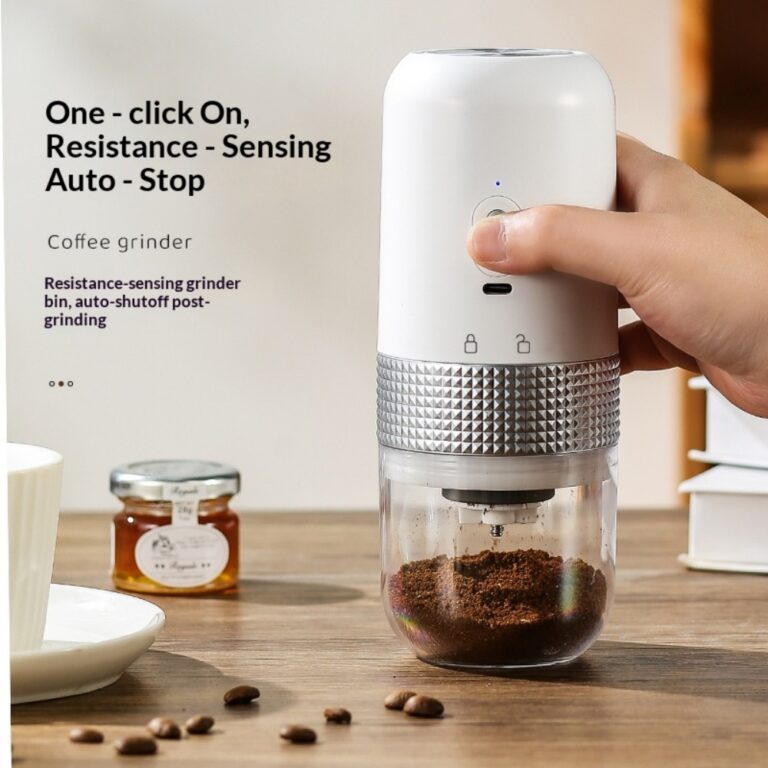
The Wireless Coffee Grinder we're looking at here delivers consistent, adjustable grinding in a compact 60mm body that fits into most travel bags and cup holders. The stainless steel conical burr and stabilized mount address the wobble problem that plagues many portable grinders. With 25+ grinding cycles on a single charge and a sound-dampened housing under 75dB, it handles the morning routine without making a scene.

The 30g capacity is honest about what it is ??not a commercial batch grinder, but exactly the right amount for one or two personal servings. That constraint is also a feature: it encourages grinding exactly what you need, when you need it, which is the whole point.
Let me be specific about where this kind of tool earns its place:
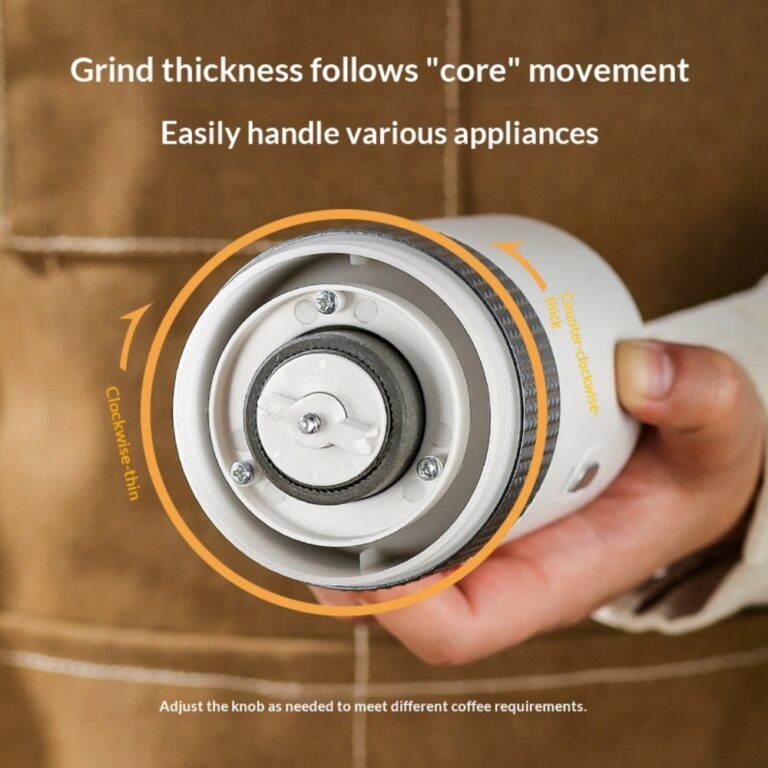
If you're new to adjusting grind size, here's a quick orientation. Think of it as a dial from fine to coarse:
The adjustable collar on a quality grinder lets you find your setting once and return to it. Mark it if needed ??consistency between sessions matters as much as getting it right on the first try.
Grinding fresh is the first step. The second is brewing shortly after. Even with good storage, ground coffee degrades faster than whole beans. Ideally, grind right before brewing ??within a minute or two.
Storage matters too. Keep whole beans in an airtight container away from heat and light. The refrigerator is actually a poor choice for most home setups ??the humidity and temperature cycles cause condensation, which degrades quality. Room temperature, sealed, dark: that's the sweet spot.
And if you're bringing a grinder on the road, a small airtight bean container keeps your beans protected during transit. Grind when you arrive, not before you leave ??the fewer steps between grinding and brewing, the better.
Here's the honest answer: if you're currently buying pre-ground coffee and satisfied with your morning cup, a grinder is going to change your expectations. Whether that's worth or depends on how much you value the difference ??and how much you drink.
For occasional drinkers, the math is harder. For anyone who has coffee every day, the upgrade from pre-ground to fresh-ground typically pays for itself within a few weeks. You're not just improving the cup. You're building a small, repeatable ritual ??and those tend to stick.
The wireless form factor just removes one of the biggest excuses: "I can't do this here." Now you can. Check the Wireless Coffee Grinder out here.
The motor and burr design matter more than the power source. A high-torque DC motor that maintains constant RPM under load will outperform a brushed motor that slows under pressure ??regardless of whether it's plugged in. The stabilized burr mount eliminates wobble, which is the main cause of inconsistent particle size in portable grinders.
Most wireless grinders in this class deliver 25+ grinding cycles per charge. With a 2000mAh battery and USB-C charging, recharging from most power banks or laptop ports is straightforward. At one to two cycles per day, you can go weeks without needing to plug in.
Quality wireless grinders typically offer adjustable settings from espresso-fine through French press-coarse. The key is finding a setting you can return to reliably ??not just having access to a wide range of numbers.
For one to two servings, yes. This is a personal grinder, not a batch grinder. The small capacity actually encourages the correct behavior: grinding exactly what you need, when you need it.
The best models run under 75dB with sound-dampened housings. For reference, a typical conversation is around 60dB, and a standard blender runs around 80-90dB. It's not silent, but it's not disruptive either.